VU Students Awarded Karapet Babajan Foundation Scholarships
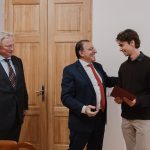
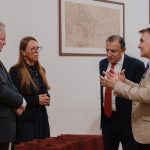
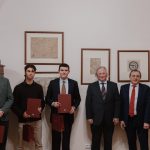
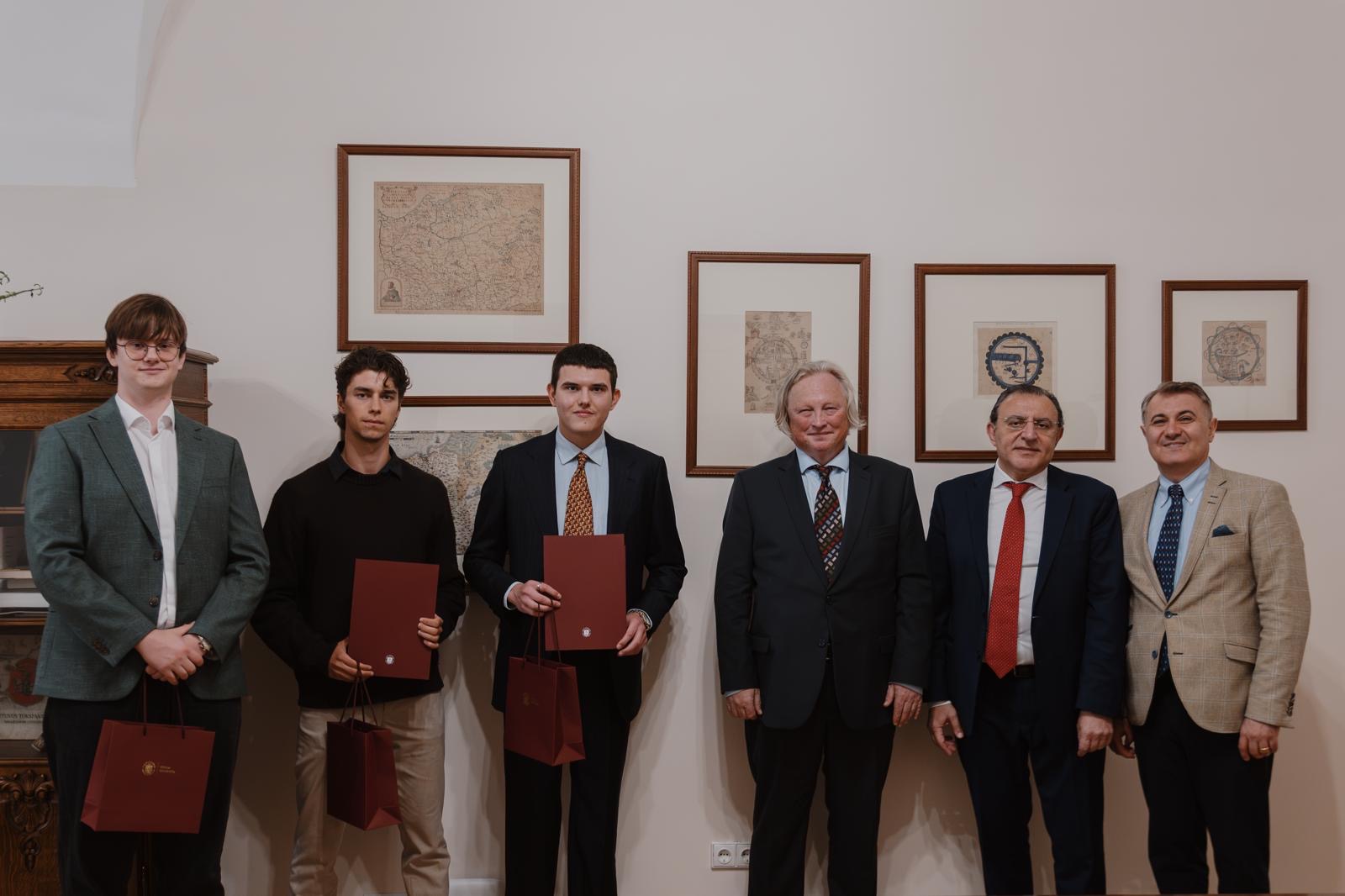
Three students at Vilnius University (VU) have been presented with certificates for the named scholarships established by the Karapet Babajan Charity and Support Foundation. The certificates were presented by VU Vice-Rector for Partnerships Dr Artūras Vasiliauskas, Honorary Consul of the Republic of Armenia in Lithuania and Director of the Karapet Babajan Charity and Support Foundation Karapet Babajan, and Ambassador Extraordinary and Plenipotentiary of the Republic of Armenia to the Republic of Lithuania Ara Margarian.
The scholarship certificates were awarded to Rokas Damulis, a student at the VU Faculty of Law, and Justina Bansevičiūtė and Elijas Bačiauskas, students at the VU Faculty of Philosophy. Povilas Stanys, a fourth-year student in the History programme at the VU Faculty of History, also attended the scholarship award ceremony. Last year, he received the first instalment of the Karapet Babajan Charity and Support Foundation named scholarship.
The Karapet Babajan Charity and Support Foundation named scholarship aims to encourage VU students to learn about and explore Armenian culture, language, history, religion and political role, as well as cooperation between the Republic of Armenia and Lithuania. Students from a wide range of study programmes and degree levels are eligible to apply.
Armenia’s Europeanisation Through the Eyes of a Law Student
Rokas Damulis, a second-year student at the VU Faculty of Law, is examining how European Union standards influence a country that is not an EU Member State. His research, entitled “European Integration Without EU Membership: How CEPA Is Shaping Armenia’s Competition Law Reform and What Lithuania’s Experience of European Transformation Means for This Process”, focuses on Armenia’s European integration and the relevance of Lithuania’s experience.
“I chose this topic because I was intrigued by Armenia’s position between different spheres of integration: it is not a member of the European Union, yet its legal system is increasingly influenced by European standards. I wanted to explore how Armenia is shaping its competition law and economic regulatory model through CEPA. Competition law seemed particularly interesting to me in this context because it allows us to observe not only the alignment of legal norms, but also broader changes in state institutions, market supervision and legal culture,” says Damulis.
How Much Armenia Is There in Lithuanian Schools?
Justina Bansevičiūtė, a fourth-year student in the Subject Pedagogy: Lithuanian Language and Foreign (French) Language programme at the VU Faculty of Philosophy, will examine the extent to which Armenia, and the ways in which it is presented, features in history education and textbooks for Lithuanian students in grades 5–12.
“I am a teacher of Lithuanian and French, and in my lessons I try to give students opportunities to discover the wider world and discuss relevant topics in history, culture and society. From what I remember of my own school years, Armenia was rarely mentioned in history or other classes. This made me curious to find out to what extent and in what ways Armenia is represented in history education for Lithuanian students in grades 5–12. I believe that by researching Armenia’s place in Lithuanian history education, I can help encourage this topic to be included more often in history lessons,” says Bansevičiūtė.
Surrounded by Empires: Parallels Between Lithuania and Armenia
Elijas Bačiauskas, a fourth-year student in the Sinology programme at the VU Faculty of Philosophy, chose to undertake a historical comparison of Lithuania and Armenia. His research is entitled “Surrounded by Empires: The Historical Struggle of Lithuania and Armenia for Freedom”.
“While studying Asian Studies at the Faculty of Philosophy, I discovered the extraordinarily diverse world of Eastern civilisations. With each year of my studies, I began to notice more and more subtle similarities intertwined with the Western world. So, when I was encouraged to explore Armenia in greater depth, I decided to compare the experiences of the people of this region with the historical memory of the Lithuanian nation. It was fascinating to notice similarities between the Lithuanian and Armenian languages, discover so many historical parallels, and see the equally tireless struggle of both nations for freedom,” says Bačiauskas.
His research has already resulted in a published article entitled “Armenia and Lithuania: What Unites the World’s First Christians and Europe’s Last Pagans?” In the article, Bačiauskas compares the histories of Lithuania and Armenia through the themes of life at a geopolitical crossroads, pressure from empires, and the preservation of national identity.
Bačiauskas was awarded the second instalment of the scholarship. Under the scholarship regulations, the first instalment is paid when the scholarship is awarded, while the remaining amount is paid once the planned work on an Armenian Studies topic has been completed and submitted.
In the Karapet Babajan Charity and Support Foundation named scholarship competition, students’ work is assessed according to the originality and relevance of the topic, the soundness of the proposed project, the expected results, and the added value it may bring to relations between Lithuania and Armenia.
Students at any stage of bachelor’s, master’s, integrated, doctoral or other degree programmes are eligible to apply for the scholarship, provided that their average grade for the previous academic year is at least 7, they are not on academic leave at the time of application, and they plan to complete a project on an Armenian Studies topic within one year of submitting their application.
The scholarship, ranging from EUR 200 to EUR 3,000, is paid in two equal instalments. The first instalment must be paid within 30 days of the scholarship committee’s decision to award the scholarship, while the second is paid upon completion of the proposed work.